Zephyr
Mariners' Museum, Uncurated Search Results
Type: Pungy
Year: 1871
Builder:
Location:
These records are found in the online catalog of The Mariners’ Museum and Park in Newport News, Virginia. Uncurated search results are presented to give researchers and interested readers an idea of whether the museum’s archives contain information about this vessel and whether it may be worthwhile to visit the museum’s catalog search page for further investigation. Uncurated results may be inaccurate or incomplete.
Search mode: Exact Name. Search phrase(s): "Zephyr". Results returned: 13. Results displayed in this table: 13.
Use these buttons to send uncurated search results to your own app or text document for further research. First, check the box for any row, or click "Select All" then uncheck any rows. Then click "Show Selections". You can then copy your selections from the text box and past them into your app.
| Fetch? | Row ID | Media | Date | Vessel | Place | Related Places | Inscription/Marks | Subject | Notes | Archive Number |
|---|---|---|---|---|---|---|---|---|---|---|
| 1 | No image URL. | Zephyr | P0001.011/01-3194 | |||||||
| 2 | No image URL. | Day boats–Design and construction | Zephyr : __a 13'6" plywood daysailer | LB102664 | ||||||
| 3 | 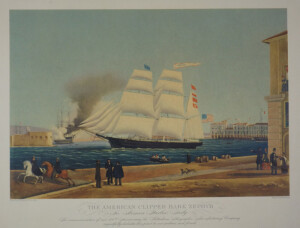 | SHORT DESCRIPTION: Port side view of the Clipper Bark Zephyr at Messina Harbor, Sicily. The ship flies a pennant with her name and an American flag. People on the shoreline continue their mundane tasks while a French Ship of the Line fires a salute as it passes the fort depicted at the left. In the foreground are two dogs and a man and woman on horseback. Another worman looks out her balcony at the right edge of the print. She stands in front of what looks like a red, white and blue banner or flag in the doorway. NOTE:The date on the print, "Circa 1842" is incorrect. The painting from which this print was taken was painted in 1860. The engraver changed the date on the print to reflect the Ketterlinus Lithographic Company's 100th Anniversary. The print was released in 1942 and it was included in their Anniversary calendars released that year. DUPLICATE NOTES: The object file indicates that there were two duplicate copies. One (1) duplicate copy was deaccessioned on February 13, l979. | CL7919 | |||||||
| 4 | No image URL. | Contains black-and-white photographs. | MS0817/01-16.217 | |||||||
| 5 | No image URL. | 1885 | Owners: Caistor Yawl Type of Incident: Grounding Location of incident: Lower Barber Sand Incident Date: July 22, 1885 Casualties: All lives saved by "The Brother" Source(s): The Graphic | MS0534/-03.47 | ||||||
| 6 | 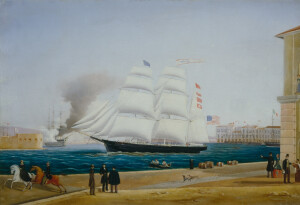 | SHORT DESCRIPTION: Port broadside view of the American bark Zephyr leaving the harbor at Messina, Sicily. In the foreground are groups of people holding conversations, a man and woman on horseback and a pair of dogs. At the upper right, a woman stands on a second story balcony in front of a red, white and blue flag or banner in the window. At the back left, a French Ship of the Line fires a salute at the fort. Zephyr flies a union flag from the foremast, a swallow-tail name pennant from the mainmast and signal flags from the mizzen and an American ensign from the gaff. NOTES: The ship might have been carrying salt to Gloucester, Massachusetts. Found newspaper reports on two barques named Zephyr in Messina in early 1860: --The New York Daily Herald, January 21, 1860, page 8, reports that the Zephyr arrived in Messina on Decemeber 23, 1859 from Marseilles. The ships master was named Small. --The Portland Press Herald, Portland, Maine, January 26, 1860, page 2 reports that on December 31st a ship named Zephyr, master named Small was supposed to leave for Boston on the "5th inst", another vessel, a bark, named Zephyr, also in Messina, but mastered by Lane, was headed for New York. --The Portland Press Herald, Portland, Maine, February 25, 1860, page 2 reports that the Zephyr mastered by Lane had arrived in Gibraltar on January 29th from Messina. It sailed on February 3rd for New York (reported in same newspaper on February 27th). --The Portland Press Herald, Portland, Maine, March 5, 1860, page 2 reported the barque Zephyr, master Small from Messina for Boston had passed Gibraltar on March 3, 1860. --The Portland Press Herald, Portland, Maine, March 23, 1860, page 2 reported the barque Zephyr, Lane, had cleared but indicates the vessel came from Marseilles. VESSEL INFORMATION - VESSEL NAME: ZEPHYR VESSEL TYPE: AMERICAN BARK VESSEL BUILT: 1855 SHIP BUILDER: S.G. BOGERT BUILDER LOCATION: NEW YORK, NEW YORK SHIP OWNERS: CHAMBERLAIN & PHELPS | CL11587 | |||||||
| 7 | No image URL. | Box 3: "Oregon" through "Zephyr" | MS0534/-03 | |||||||
| 8 |  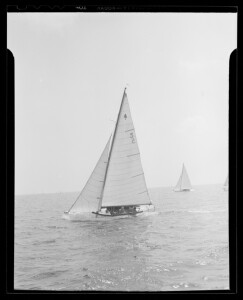 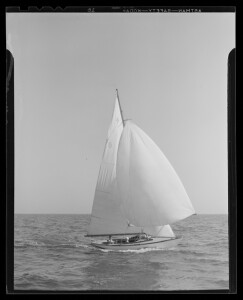 | 1937-1939 | Fire Island Lighthouse (N.Y.)–Photographs. | Fire Island (N.Y. : Island)–Photographs. | Yachts–Photographs.; Yachting–Photographs.; Yacht racing–Photographs.; Sailboats–Photographs.; Motorboats–Photographs.; Regattas–Photographs.; Lighthouses–Photographs. | Contains photographic negatives of the Timber Point class race, the yacht Winsome II, unidentified Timber Point class vessels, the yacht Three Star, the yacht First Lady, the yacht Boots, Indian Head class race start, the Indian Head class vessel Coquette, the yacht Taquarn, unidentified Safety Pin class vessels, Zephyr class vessels in race, unidentified Zephyr and Star class vessels, the Zephyr class vessel Duchess, the Zephyr class vessel Xanthippe, the Zephyr class vessel Punt Jack, the SB class vessel Sandpiper, the SB class vessel Avocet, the SB class vessel Falcon, unidentified P class vessels, the vessel Kedra, the power yacht Moana, the Fire Island Lighthouse, and the Harvard Columbus Expedition vessel Capitana. | P0002.001/50-106 | |||
| 9 | 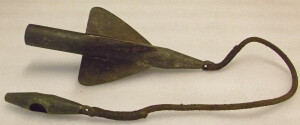 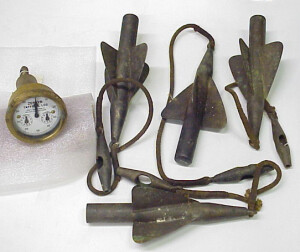 | SHORT DESCRIPTION: ’Zephir’ taffrail ship log, made by John E. HAND & Sons Co. of Philadelphia & Baltimore. With four rotators, one of which was made by The LIONEL Corporation of New York. NOTES: According to the Collection file this instrument came from the World War II navy oiler USS MISSION SANTA BARBARA. EVENT: WORLD WAR II. RESEARCHER NOTES: [Eric Lindgren, 2004] Hand's 'Zephir' (sic Zephyr) Taffrail Log: Register, 4 rotators with Lines and shells (one made by Lionel). Date: 1940-1945. Lionel rotators made 1943-1945. Register: Shoe missing, round shaft (typical of American large taffrail logs). Rotators: Hand rotators with hand/compass insignia, Lionel rotator with TL insignia. Maker History: John E. Hand & Sons Co., Deutsche Optik Catalog, Whitney 1991: 363. The Lionel Corporation. Lionel. 1943. Navigational Instruments (catalog) Osterhoff 1990: 165. Lionel Paper and Collectibles. Log References: Morzer Bruyns 1995; EWL#s 133, 335. VESSEL INFORMATION - VESSEL NAME: MISSION SANTA BARBARA. VESSEL TYPE: OILER. SS Mission Santa Barbara was a Type T2-SE-A2 tanker built for the United States Maritime Commission during World War II. After the war she was acquired by the United States Navy as USS Mission Santa Barbara (AO-131). Later the tanker transferred to the Military Sea Transportation Service as USNS Mission Santa Barbara (T-AO-131). She was a member of the Mission Buenaventura-class oiler and was named for Mission Santa Barbara in Santa Barbara, California. Mission Santa Barbara was laid down 8 April 1944 under a Maritime Commission contract by Marine Ship Corporation, Sausalito, California; launched 8 June 1944; sponsored by Mrs. Carl H. Nilson; and delivered 8 July 1944. Chartered to Pacific Tankers, Inc. for operations, she spent the remainder of the War carrying fuel to Allied bases in the Pacific. She remained in this capacity until 8 May 1946 when she was returned to the Maritime Commission and laid up in the Maritime Reserve Fleet at Olympia, Washington. Acquired by the Navy on 20 October 1947 she was chartered to Union Oil Company for operations and placed under the operational control of the Naval Transportation Service as Mission Santa Barbara (AO-131). Transferred to the new Military Sea Transportation Service on 1 October 1949 she was redesignated USNS Mission Santa Barbara (T-AO-131). She remained in service with MSTS until 12 April 1954 when she was laid up, in reserve, at the San Diego group of the Pacific Reserve Fleet. She remained in reserve until 8 October 1956 when she was once again placed in service with MSTS and chartered to the Joshua Henry Corporation for operations. She remained with MSTS until 8 November 1957 when she was transferred to the Maritime Administration (MARAD), struck from the Naval Vessel Register and laid up in the Maritime Reserve Fleet at Beaumont, Texas. However, her life was not yet over for on 26 March 1966 she was sold to the Hudson Waterways Corporation for conversion into a combination container ship and train ferry. She was renamed Seatrain Carolina on 7 April 1966. Upon completion of conversion, she carried cargo from the east coast of the United States to the Caribbean and occasionally to Vietnam. Into 1969, she was still carrying out these duties. During her active military service she was awarded the National Defense Service Medal, the Korean Service Medal (four times), the United Nations Service Medal and the Republic of Korea War Service Medal (retroactively). She also received four battle stars for her Korean War service. On 26 March 1966, she was sold to the Hudson Waterways Corp. for conversion into a combination containership and train ferry. She was renamed Seatrain Carolina 7 April 1966. Upon completion of conversion, she carried cargo from the east coast of the United States to the Caribbean and occasionally to Vietnam. 1966 SEATRAIN CAROLINA, Hudson Waterways Corp, New York. Rebuilt with forepart of FRUITVALE HILLS to form 540.9ft, 7,991 g.t. vehicle carrier. 1975 U.S. Dep't of Commerce, New York. 1978 CAROLINA, same owner. 1985 Scrapped at Kaohsiung. ADDITIONAL INFORMATION: SEE COLLECTION FILE. Sharp, A. J., "Distance Run: A History of the Patent Log", Brassbounders, Weymouth, Dorset, 1999, (book held by TMM library) LABEL COPY: Zephir Taffrail Log, c. 1944 John E. Hand & Sons, Co. Placed in the water alongside a moving vessel, a spinning rotor, such as this one, determined a ship's speed. (A to Z, 2010) | CL20700 | |||||||
| 10 | 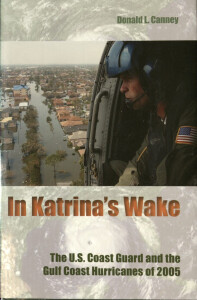 | United States. Coast Guard–History–21st century. | Gulf Coast (U.S.)–History–21st century. | Hurricanes–History–21st century. Gulf Coast (U.S.); Hurricane Katrina, 2005.; Hurricane Rita, 2005.; Rescue work–History–21st century. Gulf Coast (U.S.) | In Katrina's wake : __the U.S. Coast Guard and the Gulf Coast hurricanes of 2005 __Donald L. Canney ; foreword by James C. Bradford and Gene Allen Smith | LB107325 | ||||
| 11 | 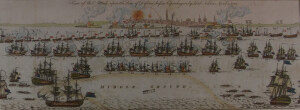 | SHORT DESCRIPTION: Hand colored view titled 'View of the Attack upon the Line of Defence, before Copenhagen, by Lord Nelson, April 2, 1801' at the top. The image shows a panorama of Lord Nelson's attack looking from the Middle Ground towards the city of Copenhagen. The Middle Ground sits at the bottom center with seven English bomb vessels anchored along its edge. Three of the vessels are in the process of lobbing bombs into the harbor and town of Copenhagen. To the left of the Middle Ground are the anchored Agamemnon, the Bellona and Russel aground, the brigs Harpy and Cruiser and several small rowing boats full of men. At the lower right is a ship of the reserve squadron and seven small rowing boats full of men. At the center of the image is a line of fourteen British warships, ten are anchored with their starboard side facing the viewer and the other four appear to be sailing towards the action with their port sides to the viewer. Beyond the British line is a line of twenty-four Danish vessels of various size (most with no masts). At the left end of the Danish line the 40 gun ship Desiree is in action with a Danish ship of the line (with no masts). Just in front of the Danish line at the right are the Crown batteries, both of which appear to be firing upon the British ships. In the background at the left is the lunette quintus, firing towards the action. To its right is the arsenal of Copenhagen, which has smoke and flames rising from its left end. To the right of the arsenal is the large citadel of Copenhagen. Smoke rises above it. Beyond the fortifications the town with many church steeples can be seen. To the right and left of the town is the green countryside with windmills. NOTES: [J. Willoz-Egnor, 4/18/2024] This is the middle section of 'Fairburn's Plan of Parker and Nelson's Victory before Copenhagen, April 2nd, 1801.' Published by John Fairburn April 22, 1801. The sections cut away show a map titled 'Passage of the Sound to Copenhagen & Draco. exhibiting the track of the British Fleet' at the top and text providing references for the view of the battle and a discussion of the action. The text at the bottom has been provided below. A full copy of the broadside is in the collection of The British Museum (accession number 1853,0212.239). The references to the numbers and letters on the engraving is as follows: British Line: 1 Polyphemus (64 guns), 2 Isis (50 guns), 3 Edgar (74 guns), 4 Ardent (64 guns), 5 Glatton (54 guns), 6 Elephant (74 guns), 7 Ganges (74 guns), 8 Monarch (74 guns), 9 Defiance (74 guns), 10 Amazon (38 guns), 11 Blanche (36 guns), 12 Alemene (32 guns), 13 Dart (30 guns), 14 Arrow (30 guns), 15 Otter (fire-ship) (14 guns), 16 Zephyr (fire-ship) (14 guns), 17 Desiree (40 guns), 18 Bellona (shown run aground) (74 guns), 19 Russel (shown run aground) (74 guns), 20 Agamemnon (shown at anchor) (64 guns), 21 Harpy (brig) (18 guns), 22 Cruiser (brig) (18 guns), 23 to 29 are the bomb vessels Discovery (16 guns), Sulphur (10 guns), Hecla (10 guns), Explosion (8 guns), Zebra (16 guns), Terror (8 guns), and Volcana (8 guns). Letter A is Sir Hyde Parker's squadron in reserve, Letter B are the Boats, ready to give assistance. Danish Line: 1 Ship of the line, 2 Ship of the line, 3 a frigate battery, 4 a frigate battery, 5 Ship of the line, 6 floating battery, 7 floating battery, 8 floating battery, 9 Ship of the line, 10 frigate battery, 11 frigate battery, 12 frigate battery, 13 Ship of the line, 14 floating battery, 15 floating battery, 16 Ship of the line, 17 frigate battery, 18 bomb vessel, 19 Ship of the line, 20 Ship of the line, 21 gun vessel, 22 gun vessel, 23 Ship of the line, 24 Ship of the line. Letters C are the Crown Islands and batteries, mounting 88 guns. D is the Citadel of Copenhagen. E is the Arsenal. F is the Lunette Quintus. The text supporting the plan is as follows: This most brilliant and unexampled Victory was achieved by that invincible Son of Neptune and Colossus of the Ocean, LORD NELSON, and the brave Officers and Men under his Command, before Copenhagen, which ended in the total Defeat of the Danish Line, Seventeen of which was Taken, Burnt, and Sunk. The British Ships, (except the 3 most damaged,) were reported ready for Sea, in less than 24 Hours after the Action. From the LONDON GAZETTE EXTRAORDINARY, April 15, 1801. ADMIRALTY-OFFICE, April 15, CAPTAIN OTWAY, of His Majesty's Ship the London, arrived this Morning with the following Dispatches from Admiral Sir Hyde Parker, Commander-in-Chief, dated on board the London, in Copenhagen Roads, the 6th Instant: SIR, ON the 30th of last Month, the Wind having come to the Northward, we passed into the sound with the Fleet, but not before I assured myself of the hostile intentions of the Danes to oppose our Passage. After anchoring about Five or Six Miles from the Island of Huin, I reconnoitered, with Vice-Admiral Lord Nelson and Rear-Admiral Graves, the formidable Line of Ships, Radeaus, Pontoons, Galleys, Fire-Ships, and Gun-Boats, flanked and supported by extensive batteries on the two islands called the Crowns; the largest of which was mounted with from fifty to seventy pieces of cannon; these were again commanded by two ships of seventy guns, and a large frigate in the Inner Road of Copenhagen; and two sixty-four gun Ships (without Masts) were moored on the Flat, on the starboard side of the entrance into the Arsenal. The day after, the wind being southerly, we again examined their position, and came to the resolution of attacking them from the Southward. Vice-Admiral Lord Nelson, having offered his services for conducting the attack, had, some days before we entered the Sound, shifted his flag to the Elephant; and after having examined and buoyed the Outer Channel of the Middle Ground, his Lordship proceeded with the twelve ships of the Line named in the reference, all the frigates, bombs, fire-ships, and all the small vessels, and that evening anchored off Draco Point to make his disposition for the attack, and wait for the wind to the southward. It was agreed between us, that the remaining ships with me should weigh at the same moment his Lordship did, and menace the Crown Batteries, and the four ships of the line that lay at the entrance of the arsenal; as also to cover our disabled ships as they came out of action. I have now the honour to enclose a copy of Vice-Admiral Lord Nelson's report to me of the action on the 2nd instant. His Lordship has stated so fully the whole of his proceedings on that day, as only to leave me the opportunity to testify my entire acquiescence and testimony of the bravery and intrepidity with which the action was supported throughout the line. Was it possible for me to add any thing to the well-earned renown of Lord Nelson, it would be by asserting, that his exertions, great as they have heretofore been, never were carried to a higher pitch of zeal for his Country's service. I have only to lament that the sort of attack, confined within an intricate and narrow passage, excluded the ships particularly under my command from the opportunity of exhibiting their valour; but I can, with great truth assert, that the same spirit and zeal animated the whole of the fleet I have the honour to be, &c H. PARKER. Elephant, off Copenhagen, 3d April, 1801. SIR, IN Obedience to your directions to report the proceedings of the squadron which you did me the honor to place under my Command, I beg leave to inform you that having buoyed the Channel of the Outer Deep, and the Position of the Middle Ground, the squadron passed in safety, and anchored off Draco the evening of the first; and that yesterday morning I made the signal for the squadron to weigh, and to engage the Danish line, consisting of six sail of the line, eleven floating batteries, mounting from twenty-six 24 pounders to eighteen 18 pounders, and one bomb-ship, besides schooner gun-vessels. These were supported by the Crown Islands mounting eighty-eight cannon, and four sail of the line moored in the Harbour's mouth, and some batteries on the island of Amak. The bomb-ship and schooner gun-vessels made their escape, the other seventeen sail are sunk, burnt, or taken, being the whole of the Danish line to the southward of the Crown Islands, after a battle of four hours. From the very intricate navigation, the Bellona and Russel unfortunately grounded, but although not in the situation assigned them, yet so placed as to be of great service. The Agamemnon could not weather the shoal of the Middle, and was obliged to anchor; but not the smallest blame can be attached to Captain Fancourt; it was an event to which all the ships were liable. These accidents prevented the extension of our line by the three ships before-mentioned, who would, I am confident, have silenced the Crown Islands, the two outer ships in the harbour's mouth, and prevented the heavy loss in the Defiance and Monarch, and which unhappily threw the gallant and good Captain Riou (to whom I had given the command of the frigates and sloops named in the margin, to assist in the attack of the ships at the harbour's mouth) under a very heavy fire; the consequence has been the death of Captain Riou, and many brave officers and men in the frigates and sloops. The bombs were directed and took their stations abreast of the Elephant, and threw some shells into the arsenal. The boats of those ships of the fleet, who were not ordered on the attack, afforded us every assistance; and the officers and men who were in them merit my warmest approbation. The Desirée took her station in raking the Southernmost Danish ship of the line, and performed the greatest service. I have the Honour to be, &c. &c. &c. NELSON and BRONTE. A list of the killed and wounded followed. At the close of this important victory, the DANISH GOVERNMENT and LORD NELSON agreed to a cessation of arms:- And on the 9th of April an armistice was signed, and concluded, between Admiral Sir Hyde Parker, Commander-in-Chief, and the Court of Denmark, by which it was agreed that no act of hostility should be committed by either party, on the coast of the islands and provinces of Denmark and Jutland, for fourteen weeks from the above date; and, after the expiration of that time, each party may declare its termination, and recommence hostilities, after giving a previous notice of fourteen days: -And also, the Court of Denmark has agreed to suspend, during that period, her active co-operation under the Treaty of the Armed Neutrality. | CL27141 | |||||||
| 12 | 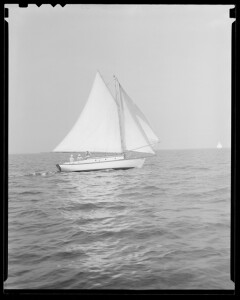 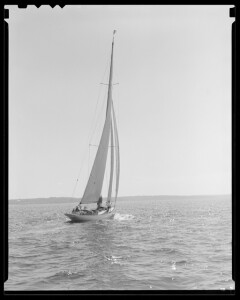 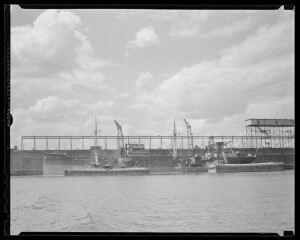 | Circa 1930 | City Island Yacht Club (N.Y.)–Photographs. | City Island (New York, N.Y.)–Photographs. | Yachts–Photographs.; Yachting–Photographs.; Yacht clubs–Photographs.; Yacht racing–Photographs.; Sailboats–Photographs.; Motorboats–Photographs.; Sloops–Photographs. | Contains photographic negatives of the City Island Yacht Club and the City Island Yacht Club Cruise, an engine at the Logue Stevedoring Corporation, the twelve meter yacht Zio, unidentified twelve meter class vessels, the yacht Gull, unidentified auxiliary sloops, the yacht Haze, unidentified 25 meter class vessels, the Weekender class yacht Ala, the yacht Dobie II, the yacht Valencia, unidentified new York 32 foot class vessels, unidentified A class vessels, the A class yacht Zephyr, the A class yacht Rampage, unidentified M class vessels, and various unidentified sailing and power yachts at the City Island Yacht Club. | P0002.001/50-075 | |||
| 13 | 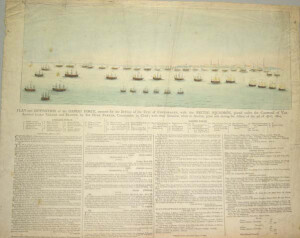 | SHORT DESCRIPTION: At the top of the engraving is a colored scene showing the layout of the Danish force as they prepared to protect the city against attack by the British fleet in 1801. The city of Copenhagen is visible behind the line of battle ships. All of the vessels are numbered and identifed. Under the scene are transcriptions of letters by Sir Hyde Parker and Colonel Henrik Stricker and an account of the battle with a list of those killed and wounded by Horatio Nelson. NOTES: Edward Riou was baptized in 1762 by his parents, Stephen and Dorothy Riou. He joined the Royal Navy at the age of 12 and served on two different ships before joining Captain Charles Clerke and HMS Discovery on February 22, 1776 as part of Captain James Cook’s third and final voyage to explore the Pacific. With his shipmate, William Bligh, Riou must have witnessed at least some small part of the interaction in February 1779 between Cook and the Hawaiians as the two sides clashed and Cook eventually lost his life. Riou kept a log while onboard, which described how Riou found a dog while Discovery and Resolution and their crews visited New Zealand. Apparently the dog’s favorite pastime while sailing was to nip at and bite the crew who were not at all fond of the animal. When the ship next pulled into port the crew accused the dog of crimes, held a trial, found the dog guilty, and then killed and ate him. After Captain Cook was killed in Hawaii, Captain Clerke took command of Cook’s HMS Resolution and brought Riou to that ship to finish out the voyage. Between 1780 and 1789 Riou served on three other ships before receiving command of HMS Guardian, for which he became famous for hitting an iceberg and keeping the ship from sinking for two months and saving the crew and convicts that remained with the ship. After surviving the iceberg and near sinking, he rose in ranks until he found himself captain of HMS Amazon under Vice Admiral Horatio Nelson. During the Battle of Copenhagen, when Nelson was forced to attack Trekroner Fort after the Dutch allied themselves with the hated French, Riou was in charge of the smaller boats and frigates. While the battle raged, he saw Admiral Parker’s signal to retreat. Not being able to see Nelson’s HMS Elephant, he began turning Amazon around. About that time, he was wounded in the head by a large wooden splinter. His crew described him sitting on a gun carriage, tending to his head, and directing and encouraging his crew when a cannonball came directly for him, hitting him in the mid-section and leaving two parts of Captain Edward Riou for the crew to mourn. Admiral Parker’s signal to retreat is the same signal to which Nelson reportedly said, “I have only one eye...and I have the right to be blind sometimes...I really do not see the signal.” Nelson then raised his telescope to his blind eye, ignored the signal, and continued to fight and win. While this is not the origin of the phrase, “to turn a blind eye,” it helped to popularize it. | CL15327 |
Created 2026 by Don Barker, CBMM volunteer, for the Chesapeake Shipbuilding Project. shipbuilding@sailingworkboats.es